Unlocking the Power of Monochrome Abstract Linear Patterns in Modern Design
In a world saturated with vibrant colors and complex imagery, there is a distinct, calming power found in simplicity. This is the realm of abstract linear patterns, specifically those that utilize monochrome palettes to create seamless, repeating visual experiences. Whether you are a graphic designer seeking fresh inspiration, an interior decorator looking to add texture without clutter, or simply someone who appreciates the beauty of mathematical precision, understanding these patterns opens a door to a versatile design language.
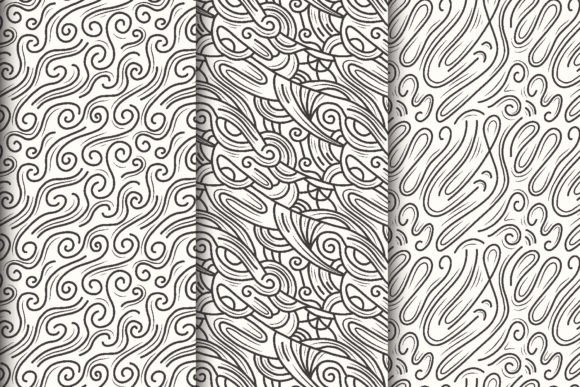
At its core, this style of art relies on the interplay between wavy contours and straight lines. By stripping away color, the focus shifts entirely to rhythm, flow, and structure. These designs are not merely decorative; they serve functional roles in branding, web development, fashion, and architectural visualization. Let's explore what makes abstract seamless line art so significant and how it fits into our modern lives.
The Essence of Monochrome Line Art
To understand the appeal of these patterns, we must first deconstruct their fundamental elements. A monochrome pattern uses only one color hue (often black) against a contrasting background (usually white), relying on shades of gray to create depth if necessary. When combined with abstract wavy contours, the result is a visual rhythm that mimics natural phenomena—think of ripples in water, wind blowing through grass, or the gentle curves of a coastline.
The term "seamless" is crucial here. In technical terms, a seamless pattern is designed so that it can be tiled infinitely without visible breaks or edges. This allows designers to apply the pattern to any surface area, from a small business card to a massive billboard, without losing continuity. The repeating linear nature creates a sense of order and predictability that the human brain finds soothing, making these patterns highly effective for backgrounds where text or other focal points need to remain legible.
Why Simplicity Wins in a Complex World
We live in an era of information overload. Our eyes are constantly bombarded by high-definition images, neon advertisements, and chaotic digital interfaces. In response, modern design trends have shifted towards minimalism. Abstract line art offers a sophisticated alternative to heavy textures or bold colors. It provides visual interest without demanding attention. This subtlety is why these patterns are increasingly popular in user interface (UI) design, where the goal is often to guide the user's eye rather than distract them.
Furthermore, the monochrome aspect ensures versatility. Because the pattern lacks specific color associations, it can be easily adapted to fit any brand identity. A black-and-white wavy line pattern can be recolored to match a corporate blue or a trendy pastel pink instantly, maintaining its structural integrity while changing its mood.
Practical Applications in Business and Creativity
The utility of abstract linear patterns extends far beyond mere aesthetics. They are tools that solve practical problems in various industries. Understanding their application helps clarify why they are such a staple in professional creative work.
- Branding and Identity: Companies often use subtle background patterns on websites and marketing materials to establish a unique texture. A logo might be placed over a monochrome repeating linear pattern to give the page depth without overwhelming the message. This technique adds a layer of professionalism and polish that flat colors cannot achieve.
- Fashion and Textile Design: In the world of fabric, seamless line art is king. Manufacturers print these patterns onto silk, cotton, and synthetic blends to create clothing that looks dynamic even when still. The wavy contours create an optical illusion of movement, making garments appear fluid and elegant as the wearer moves.
- Interior Architecture: Wallpaper and wall coverings often utilize these designs to alter the perception of space. Vertical wavy lines can make a room feel taller, while horizontal waves can widen a narrow hallway. The lack of color prevents the room from feeling small or claustrophobic, which is a common issue with busy, colorful wallpapers.
- Digital Backgrounds: For software developers and app creators, loading screens and login pages benefit greatly from these patterns. They provide a visually engaging backdrop that loads quickly because vector-based line art requires less data than rasterized photographs.
Bridging Nature and Geometry
One of the most fascinating aspects of abstract seamless line art is its ability to bridge the gap between organic nature and rigid geometry. Pure geometric shapes, like squares and triangles, can feel cold and artificial. Conversely, purely organic shapes can feel messy and unstructured. Abstract linear patterns strike a perfect balance.
By using lines that curve and undulate, designers mimic the irregularity found in nature. However, because these lines are drawn with mathematical precision and repeat in a predictable cycle, they retain the order of engineering. This duality is what makes the patterns so compelling. They remind us of the underlying order in the universe—the way sand dunes form, the way sound waves travel, or the way neural networks fire in the brain.
This connection to natural forms has a psychological impact. Studies suggest that humans have an innate preference for patterns that reflect natural fractals. While a solid block of color can feel static, a monochrome pattern with wavy contours engages the viewer's subconscious, creating a sense of calm and engagement simultaneously.
Common Misunderstandings About Abstract Patterns
Despite their widespread use, there are several misconceptions about abstract linear patterns that can limit their potential. Addressing these misunderstandings is key to mastering their use.
- Misconception: They are boring or too simple. Many beginners assume that removing color removes value. In reality, removing color forces the designer to focus on composition, spacing, and line weight. A well-crafted monochrome pattern can be more striking than a chaotic, multi-colored one because every element serves a purpose.
- Misconception: They are difficult to create. With modern software, creating seamless patterns is easier than ever. Tools allow designers to draw a single segment and automatically tile it, checking for alignment errors instantly. The skill lies not in the creation, but in the conceptualization of the flow.
- Misconception: They are outdated. Some believe that line art is a relic of the 1970s or 80s. On the contrary, with the rise of "Neo-Brutalism" and "Swiss Style" in web design, clean, monochrome line patterns are experiencing a massive resurgence. They represent a return to clarity and readability in digital spaces.
How to Integrate These Patterns Into Your Workflow
If you are looking to incorporate abstract wavy contours into your projects, start by observing the environment around you. Look at the shadows cast by trees, the reflection of light on a rippled pond, or the stitching on a piece of fabric. These are your source materials.
When creating or selecting a pattern, consider the scale. A pattern that works beautifully on a large format poster might look muddy on a mobile screen. Always test your design at different sizes. Additionally, pay attention to the line weight. Thicker lines create a bolder, more graphic look, while thin lines offer elegance and delicacy. Mixing line weights within a single monochrome pattern can add a surprising amount of complexity and visual hierarchy.
For those working in education or presentations, these patterns can be excellent tools for breaking up dense text. Instead of using a plain white slide, overlay a very faint, low-opacity repeating linear pattern to add a touch of personality without distracting from the content. This technique improves retention and keeps the audience engaged.
The Future of Minimalist Design
As technology advances, the demand for efficient, scalable, and aesthetically pleasing graphics will only grow. Abstract linear patterns are perfectly suited for this future. They are lightweight, scalable to any resolution, and timeless in their appeal. As virtual reality and augmented reality become more prevalent, the need for backgrounds that do not cause visual fatigue will increase. Monochrome line art provides the perfect solution—a background that exists in the periphery, supporting the experience without dominating it.
Whether you are designing a website, printing a brochure, or simply decorating your home, the principles of abstract seamless line art offer a powerful toolkit. By embracing the interplay of waves and lines, and trusting the power of monochrome, you can create work that is both modern and enduring. The next time you see a simple pattern of wavy lines, remember that beneath its simplicity lies a complex harmony of math, nature, and human psychology waiting to be explored.