July Watercolor Patterns: A Comprehensive Evaluation for Designers and Crafters
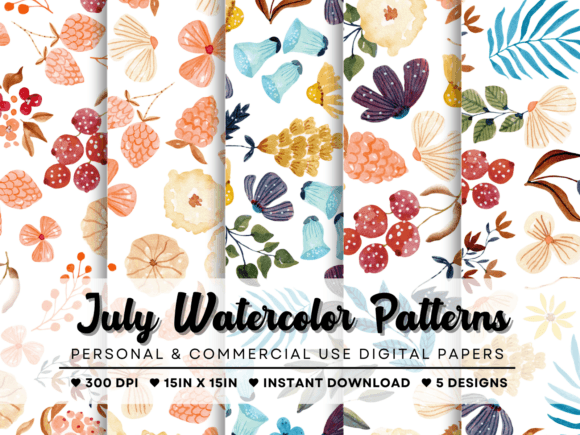
In the landscape of digital design assets, July Watercolor Patterns represents a specific collection of artistic resources designed to bridge the gap between traditional hand-painted aesthetics and modern digital application. This collection consists of five distinct seamless patterns characterized by floral motifs rendered in a watercolor style. For professionals and hobbyists alike, understanding the technical specifications, aesthetic qualities, and practical applications of this set is essential before integrating it into a project workflow.
The core value proposition of this asset lies in its versatility. It is not merely a background image but a functional texture library intended for high-resolution output. The collection includes multiple file formats tailored to different software environments, ensuring that the user can utilize the art across various platforms without compromising quality or compatibility.
Understanding the Technical Specifications
When evaluating any digital pattern pack, the first step is to scrutinize the file formats and resolution. July Watercolor Patterns offers a robust suite of files designed to maximize usability:
- PNG Files (Transparent Background): The inclusion of 5 x PNG files at 3600x3600 pixels allows designers to overlay the floral textures onto existing designs without leaving a white box around the edges. This is critical for projects requiring layering, such as placing a pattern behind text on a business card or integrating it into a complex web layout.
- JPG Files (White Background): Alongside the transparent versions, 5 x JPG files are provided with a white background. These are ideal for print-on-demand services that require solid backgrounds or for users who prefer a quick drop-in solution where transparency is not necessary.
- .PAT File Format: One of the most valuable features for graphic designers is the inclusion of the .PAT file. This format allows Adobe Photoshop and similar software to recognize the image as a native fill pattern. Users can apply the design instantly via the paint bucket tool or pattern stamp brush, enabling rapid prototyping and consistent tiling across large surfaces.
The resolution of 3600x3600 pixels at 300 DPI ensures that these patterns meet the rigorous standards of professional printing. At this density, the artwork remains crisp when printed on standard paper stock, making it suitable for physical products like invitation cards, gift wrapping, and posters.
Primary Applications and Use Cases
The versatility of these seamless patterns makes them applicable across a wide spectrum of creative industries. The decision to use July Watercolor Patterns often depends on the specific medium being targeted.
Digital Branding and Social Media
In the realm of digital marketing, visual consistency is paramount. These patterns serve as excellent base layers for Instagram story backgrounds, website headers, and email newsletters. The floral theme suggests a soft, organic, and approachable brand identity, which aligns well with businesses in the lifestyle, wellness, and boutique sectors. Using the transparent PNG version allows for sophisticated compositing, where the pattern can be blended with other elements to create depth without obscuring key information.
Printed Materials and Stationery
For physical goods, the 300 DPI resolution is a non-negotiable requirement. This collection is particularly well-suited for:
- Invitations and Greeting Cards: The hand-painted quality adds a touch of elegance and personalization that vector graphics often lack.
- Business Cards: Subtle pattern fills can elevate the tactile feel of a card, distinguishing it from competitors using plain solid colors.
- Scrapbooking and Paper Crafts: Digital scrapbookers can utilize the .PAT file or high-res JPGs to create virtual layouts that mimic the look of real paper crafts.
Home Decor and Textiles
The seamless nature of the design means it can repeat infinitely without visible seams. This characteristic is highly desirable for creating surface textures for textiles, wallpaper, or desktop wallpapers. When applied to a digital mockup of a fabric, the watercolor effect provides a soft, artistic finish that appeals to consumers looking for unique, handmade-style home decor items.
Balancing Benefits and Considerations
While the asset offers significant advantages, a balanced evaluation requires an examination of potential tradeoffs and limitations.
Strengths
The primary strength of this collection is the combination of high resolution and format variety. Many free or low-cost assets provide only one file type, forcing the user to convert images manually, which can degrade quality. The inclusion of both transparent PNGs and native .PAT files saves time and preserves the integrity of the original artwork. Furthermore, the "hand-painted" aesthetic offers a level of imperfection and organic flow that resonates more deeply with audiences than rigid, mathematical geometric patterns.
Limitations and Tradeoffs
However, there are considerations regarding the color palette and complexity. Watercolor patterns are inherently light and airy; they may not provide enough contrast for text-heavy designs if used as a full background without modification. Designers must be prepared to adjust opacity or place text boxes over solid areas to ensure readability.
Additionally, while the resolution is sufficient for standard printing sizes, extremely large-scale prints (such as billboards) might reveal pixelation if the image is scaled beyond its native dimensions. While 3600x3600px is generous for most uses, it is not infinite scalability.
Situational Fit: When to Choose This Collection
This specific set of July Watercolor Patterns is a strong fit for users who prioritize an organic, artisanal aesthetic. If your goal is to create content that feels human-made rather than machine-generated, this collection aligns perfectly with those objectives. It is particularly effective for:
- Wedding and Event Planning: Where themes often revolve around nature, romance, and softness.
- E-commerce Product Mockups: Specifically for brands selling candles, soaps, jewelry, or botanical products.
- DIY Enthusiasts: Those engaging in scrapbooking or digital crafting who need high-quality textures to simulate physical materials.
Alternatives and Comparative Analysis
Conversely, there are scenarios where July Watercolor Patterns may not be the optimal choice. If a project demands a bold, high-contrast, or corporate aesthetic, the soft floral motifs might clash with the desired tone. In such cases, geometric patterns, abstract shapes, or monochromatic textures would be more appropriate.
Furthermore, if the project requires extreme customization of individual flower elements (e.g., changing the color of a single petal), a raster-based watercolor pattern is less flexible than a vector illustration. Vector assets allow for infinite scaling and color manipulation without loss of quality, whereas these patterns are fixed images. For projects requiring heavy editing of the floral elements themselves, a vector bundle would offer greater utility.
Conclusion: Making an Informed Decision
Selecting the right digital asset involves matching the technical capabilities of the file with the artistic goals of the project. July Watercolor Patterns delivers on its promise of high-quality, versatile floral textures. The provision of multiple formats—PNG, JPG, and PAT—ensures that it can be integrated into diverse workflows, from web design to commercial printing.
Ultimately, the decision to utilize this collection should hinge on the desired mood of the final output. If the objective is to convey warmth, creativity, and a handcrafted feel, this pattern set is a reliable and practical resource. By understanding its strengths in high-resolution printing and its limitations regarding color flexibility, designers can effectively incorporate these patterns into their work to achieve professional results.